AMD Revives HEDT: Threadripper 9000 Launches July 31, From $1,499
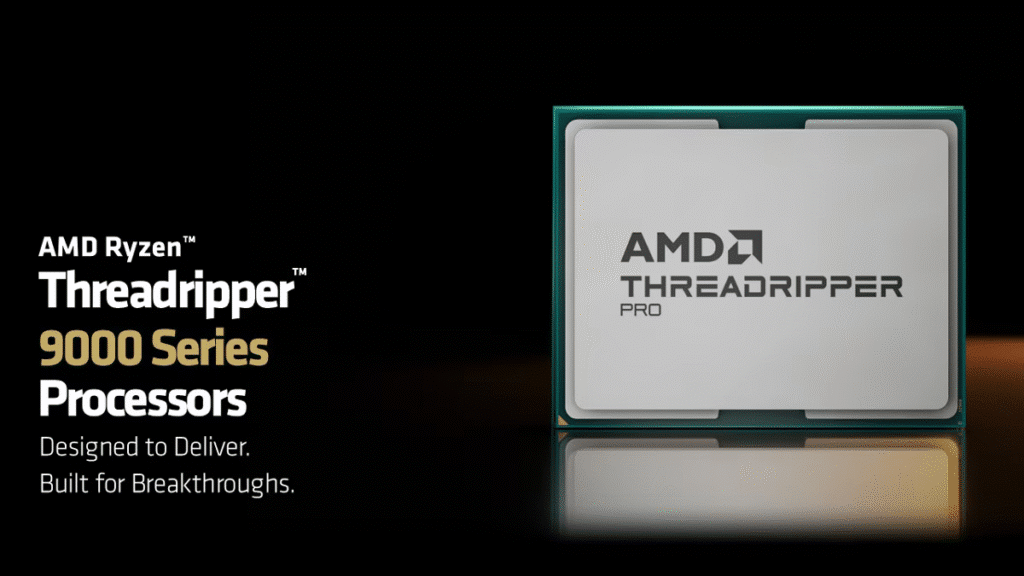
AMD is gearing up to reintroduce high-end desktop computing with its Threadripper 9000 family, officially debuting on July 31. Built on Zen 5 architecture, the lineup targets power users and content creators who demand extreme multi-threaded performance — the kind of workloads where traditional consumer CPUs start to show their limitations.
In parallel, AMD is also rolling out the Threadripper PRO 9000 WX series, aimed squarely at professionals needing even more I/O and memory bandwidth. Visit AMD
Below is a deeper breakdown of the architecture, specifications, performance claims, platform, and strategic positioning.
What’s New in Threadripper 9000
Up to 64 cores / 128 threads, with boost clocks reaching 5.4 GHz
Maintained price tiers:
- 24-core model at $1,499
- 32-core at $2,499
- 64-core flagship at $4,999
The series is positioned between AMD’s mainstream Ryzen lineup and the PRO/WX workstation class, offering many of the high-performance perks of PRO without going full enterprise price. Visit Tom’s Hardware
Key Specs & Platform Features
The Threadripper 9000 chips slot into the TRX50 platform, boasting:
- Quad-channel DDR5-6400 RDIMM memory support
- Up to 80 PCIe 5.0 lanes (plus some PCIe 4.0)
- 350 W TDP for all SKU variants
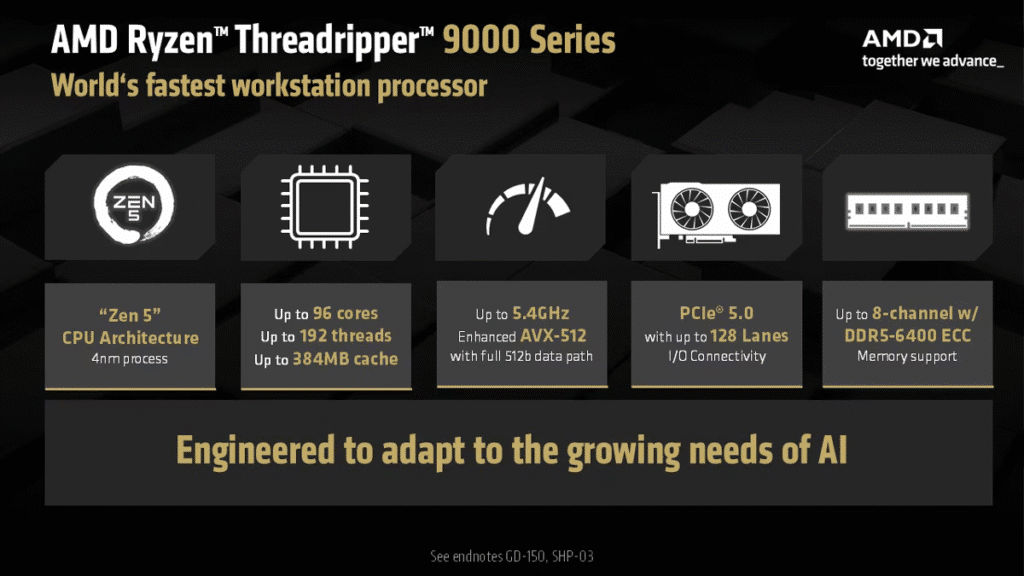
- Full AVX-512 support with a 512-bit data path
- Overclocking capability is maintained from previous generations
AMD claims the flagship 9980X can rival or exceed Intel’s 60-core Xeon W9-3595X in compute-heavy tasks, while the 9970X with 32 cores even outpaces Intel’s 44-core W9-3575X in certain workloads.
Ryzen Threadripper 9000 Specifications and Pricing
|
CPU Model |
Series |
Cores / Threads |
Base / Boost Clock |
L3 Cache |
Memory Support |
PCIe Lanes |
TDP |
Price (USD) |
|---|---|---|---|---|---|---|---|---|
|
Threadripper 9980X |
9000 HEDT (Zen 5) |
64C / 128T |
3.2 / 5.4 GHz |
256 MB |
Quad-channel DDR5-6400 (Up to 1TB) |
Up to 80 PCIe 5.0 |
350W |
$4,999 |
|
Threadripper 9970X |
9000 HEDT (Zen 5) |
32C / 64T |
4.0 / 5.4 GHz |
128 MB |
Quad-channel DDR5-6400 |
Up to 80 PCIe 5.0 |
350W |
$2,499 |
|
Threadripper 9960X |
9000 HEDT (Zen 5) |
24C / 48T |
4.2 / 5.4 GHz |
128 MB |
Quad-channel DDR5-6400 |
Up to 80 PCIe 5.0 |
350W |
$1,499 |
|
Threadripper PRO 9995WX |
9000 PRO (Zen 5) |
96C / 192T |
2.5 / 5.4 GHz |
384 MB |
Octa-channel DDR5-6400 (Up to 2TB) |
Up to 128 PCIe 5.0 |
350W |
$11,699 |
|
Threadripper PRO 9985WX |
9000 PRO (Zen 5) |
64C / 128T |
3.2 / 5.4 GHz |
256 MB |
Octa-channel DDR5-6400 |
Up to 128 PCIe 5.0 |
350W |
$7,999 |
|
Threadripper PRO 9975WX |
9000 PRO (Zen 5) |
32C / 64T |
4.0 / 5.4 GHz |
128 MB |
Octa-channel DDR5-6400 |
Up to 128 PCIe 5.0 |
350W |
$4,099 |
|
Threadripper PRO 9965WX |
9000 PRO (Zen 5) |
24C / 48T |
4.2 / 5.4 GHz |
128 MB |
Octa-channel DDR5-6400 |
Up to 128 PCIe 5.0 |
350W |
$2,899 |
|
Threadripper PRO 9955WX |
9000 PRO (Zen 5) |
16C / 32T |
4.5 / 5.4 GHz |
64 MB |
Octa-channel DDR5-6400 |
Up to 128 PCIe 5.0 |
350W |
$1,649 |
The new lineup is built for AMD’s TRX50 platform, offering quad-channel DDR5-6400 RDIMM memory and support for up to 80 PCIe 5.0 lanes (92 in total, including 8 PCIe 4.0). This setup delivers twice the memory bandwidth of standard desktop platforms, giving creators ample throughput for demanding GPUs, high-speed storage, and data-intensive workflows. As with previous generations, overclocking remains fully supported right out of the box.
Ryzen Threadripper 9000 Architecture & Microarchitectural Gains
Zen 5 Foundation, AVX-512, and Core Design
The Threadripper 9000 family is built on the Zen 5 microarchitecture, which brings several enhancements over prior generations: better instruction throughput, improved branch prediction, and more efficient execution pipelines.
A standout feature is full 512-bit AVX-512 support with a broad datapath, which benefits AI, signal processing, scientific compute tasks, and certain media workflows.
AMD has also tuned the memory and cache subsystems: Threadripper 9000 supports DDR5-6400 in quad-channel mode (for the non-PRO line), and ECC RDIMM support is included.
Generational uplift claims are modest but meaningful: AMD cites ~16 % faster performance in workstation-style tasks compared to its prior-generation Threadripper 7000 series, and up to ~25 % gains in AI/ML workloads.
Third-party testing provides early corroboration: Puget Systems found the 9960X to be ~21 % faster than the earlier 7960X in content creation workloads, while the 9970X and 9980X posted ~10 % improvements over previous equivalents.
Ryzen Threadripper 9000 Models, Clocks & Cache
SKU Lineup & Pricing (Non-PRO HEDT)
|
Model |
Cores / Threads |
Base / Boost |
L3 Cache |
Memory Channels |
TDP |
Launch SEP / Price* |
|---|---|---|---|---|---|---|
|
9960X |
24 / 48 |
~4.2 GHz / 5.4 GHz |
128 MB |
4-channel DDR5-6400 |
350 W |
$1,499 |
|
9970X |
32 / 64 |
~4.0 GHz / 5.4 GHz |
128 MB |
4-channel DDR5-6400 |
350 W |
$2,499 |
|
9980X |
64 / 128 |
~3.2 GHz / 5.4 GHz |
256 MB |
4-channel DDR5-6400 |
350 W |
$4,999 |
* SEP = suggested retail price at launch.
These prices essentially mirror the prior generation Threadripper series, meaning AMD is keeping the cost structure consistent despite architectural upgrades.
Clock speeds reflect a downward trend in base frequencies as core counts rise, but all models can reach 5.4 GHz in boost.
Ryzen Threadripper 9000 Platform, Compatibility & I/O
Socket & Chipsets
Both the Threadripper 9000 (HEDT) and PRO lines use socket sTR5.
Two chipsets are defined:
- TRX50 – for the consumer/enthusiast (non-PRO) Threadripper line. Supports quad-channel DDR5 (up to 1 TB), and up to 80 PCIe 5.0 lanes (usable ~92 total lanes, 88 usable)
- WRX90 – for the PRO WX series. It supports 8 memory channels (up to 2 TB DDR5), and up to 128 PCIe 5.0 lanes (usable ~144 total, 128 usable)
Importantly, TRX50 motherboards will support both non-PRO and PRO processors (after BIOS updates), while WRX90 boards are dedicated to PRO chips.
Legacy compatibility is strong: sTR5 is the same socket used by Threadripper 7000, so many existing high-end desktop motherboards and cooler solutions are expected to remain compatible (with BIOS updates).
Memory & Storage
- Non-PRO Threadripper 9000: quad-channel DDR5-6400 RDIMM with ECC support.
- PRO WX series: supports octa-channel (8-channel) DDR5-6400, including ECC and registered memory.
- Storage and GPU connectivity benefit from PCIe 5.0 lanes. Non-PRO line supports up to 80 PCIe 5.0 lanes; PRO supports up to 128.
Thermal & Power
Every Threadripper 9000 variant (PRO and non-PRO) is rated at a 350 W TDP / PPT envelope.
Because of the high power draw, robust cooling (e.g., high-end air or liquid cooling) is essential, especially under full load or mixed compute workloads.
Threadripper Performance & Benchmarks
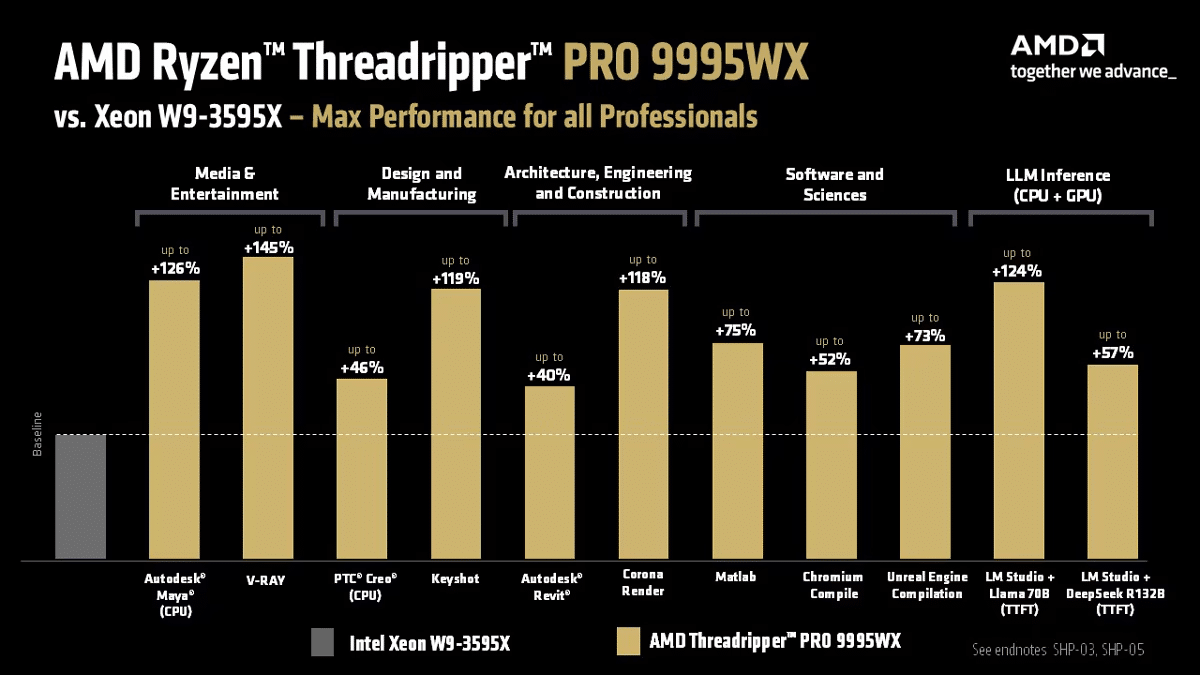
AMD has presented internal benchmarks showing large uplifts over rival Intel Xeon W-series parts. In some professional workloads, AMD claims 2× performance gains in media/rendering, architectural workloads, and AI tasks.
In their tests, Threadripper PRO 9995WX delivers 13–26 % generational uplift in workstation benchmarks and ~22–23 % gains in AI/ML compared to the predecessor PRO 7995WX.
Other early data:
- In TechSpot’s review of 9980X/9970X, the chips show excellent multi-threaded throughput and robust scaling across many cores.
- HotHardware, in its 9980X/9970X review, calls this series AMD’s “most powerful HEDT and workstation processors ever,” noting improved efficiency, performance, and upward compatibility.
- Puget Systems finds that 9960X is ~21 % faster vs the earlier 7960X in content creation, and the 9970X/9980X yield ~10 % generational gains.
That said, because many of the early performance claims derive from AMD’s internal benchmarks or press review units, real-world performance in mixed workflows, gaming, and under sustained workloads will matter for end users.
One of the most compelling parts of AMD’s strategy is keeping prices flat despite the architectural upgrades. The pricing mirrors the previous generation, which suggests AMD is serious about making HEDT viable again.
By doing so, AMD is staking a claim in the territory between mainstream desktops and full-blown workstations. This has special appeal to creators, AI developers, and power users who need high memory bandwidth, many PCIe lanes, and massive multi-core headroom — but don’t need (or won’t pay for) all the extras that come with the PRO-class gear.
In the broader landscape, this move also puts pressure on Intel’s Xeon W lineup, where AMD hopes to deliver better performance-per-dollar in high-end compute tasks.